For small businesses, office cleaning often falls into a grey area. It's not large enough to warrant a full-time cleaning staff member, but it's too important to ignore or leave entirely to the team. This guide looks at the practical side of maintaining a clean, hygienic workplace — what genuinely matters, how to approach it without overcomplicating things, and when professional cleaning makes the most sense.
The context here is specifically small businesses: offices with perhaps 2 to 30 people, typically renting commercial space. The principles apply whether you're in a converted unit, a co-working building with private offices, or a traditional office layout.
Why Workplace Cleanliness Matters More Than It Might Seem
It's easy to treat office cleaning as a background concern — something to deal with when it becomes visibly necessary. In practice, the state of a workplace has effects that are felt well before things reach that point.
Dust accumulation on desks and shared equipment, particularly monitors and keyboards, contributes to poor air quality and can aggravate respiratory conditions. In shared kitchens and break areas, poor hygiene creates conditions for bacteria and mould. In spaces where clients or customers visit, the cleanliness of an office sends a signal about how a business operates — consciously or not.
There's also a straightforward staff wellbeing dimension. Most people find it harder to focus in a cluttered or poorly maintained environment. This isn't about demanding immaculate surroundings, but about the difference between a space that feels cared-for and one that clearly isn't.
The Areas That Need the Most Attention
Shared kitchen and break areas
These are, consistently, the areas that deteriorate most quickly and have the most significant hygiene implications. Shared kitchens in small offices are used frequently by everyone and cleaned by no one unless clear responsibility is assigned.
Daily minimum for a shared kitchen:
- Surfaces wiped down at the end of the day
- Dishes washed and not left in the sink overnight
- Spillages and crumbs dealt with as they happen
- Bin emptied when full, not left to overflow
Weekly tasks:
- Microwave interior cleaned
- Refrigerator checked for outdated items and wiped down
- Kettle descaled if limescale is building up
- Floor mopped
The most common failure point is unclear responsibility. If everyone assumes someone else will deal with the kitchen, it won't get done. A simple rota or clearly assigned responsibility (ideally to a specific person or to a professional cleaner) is more effective than general expectations.
Toilets and washrooms
Washroom cleanliness is one area where there's very little tolerance for lapses, from both a hygiene and a staff satisfaction standpoint. For small offices, this typically means:
- Daily cleaning of toilet bowls, seats, and surrounding areas
- Regular checking and restocking of soap, hand towels, and toilet paper
- Sink and tap cleaning to prevent limescale and soap residue
- Floor cleaning — mopped at least twice a week
- Bin emptied regularly
In higher-use offices, daily professional cleaning of washrooms is often worth the cost given the impact on staff and visitor experience.
Workstation and desk areas
Keyboards, mice, and monitors accumulate dust and bacteria over time. While it's reasonable for staff to take some responsibility for their own workstations, there's a distinction between personal tidiness and hygiene maintenance of shared or communal equipment.
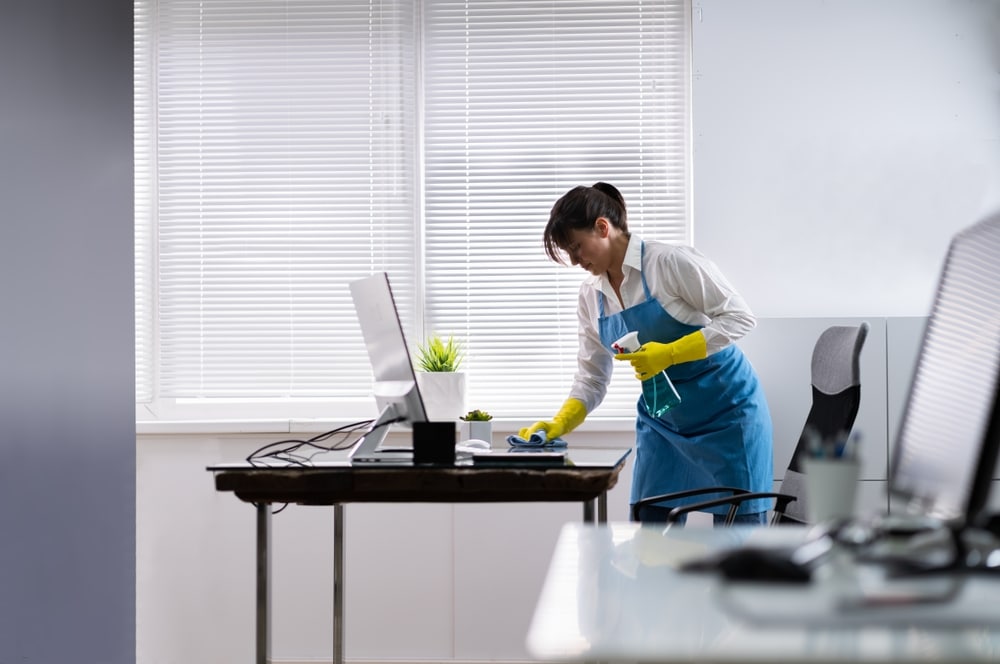
A weekly wipe-down of shared desks, meeting room tables, and video conferencing equipment is a reasonable baseline. Providing microfibre cloths and a suitable multi-surface cleaner makes it easy for staff to keep their areas tidy without requiring a professional for every task.
Reception and client-facing areas
If your office has a reception area or a meeting room used for client visits, these spaces warrant more frequent attention than back-office areas. They're the first thing visitors see, and the impression they make — positively or negatively — tends to stick.
Daily tidying of reception areas and regular cleaning of meeting rooms (ideally before each client visit, as well as a general clean at least once a week) is a sensible standard.
Frequency: A Practical Framework
The right cleaning frequency for a small office depends on the number of staff, the nature of the work, and how much client footfall the office receives. As a general framework:
Daily (or every working day): Kitchen surfaces and dishes, toilet and washroom clean, bin emptying, spot-cleaning of visible marks and spills, reception area tidy.
Weekly: Vacuuming or sweeping all floors, mopping hard floors, thorough desk and surface wipe-down, meeting room deep clean, window ledges and sills, kitchen fridge and appliance check.
Monthly: Window cleaning (internal), skirting boards, door handles and switches, air vents and extractor fans, deeper clean of kitchen appliances.
Quarterly or as needed: Upholstered furniture (sofas, chairs), carpet deep-cleaning, thorough sanitisation of high-touch areas, external window cleaning.
Professional Cleaning vs In-House Responsibility
Many small businesses try to manage cleaning entirely through staff responsibility — either informally or through cleaning rotas. This can work for some tasks, but it comes with limitations.
Staff-managed cleaning tends to be inconsistent, particularly when workloads are high. It can create friction in small teams when responsibilities aren't clearly defined or equally shared. And it typically doesn't cover the kind of systematic, thorough cleaning that prevents hygiene issues from developing over time.
Professional cleaning services for small offices usually cover:
- Vacuuming and mopping all floor areas
- Thorough kitchen clean including appliances and surfaces
- Washroom and toilet cleaning and restocking
- Desk and surface wiping
- Bin emptying and liner replacement
- Meeting room cleaning and setup
For most small offices, a professional clean two to three times per week is sufficient, with daily staff responsibility for the kitchen between those visits. For higher-footfall offices or those with client-facing spaces, daily professional cleaning makes more sense.
What to Look for When Choosing a Cleaning Service
If you're considering professional office cleaning for the first time or switching providers, a few things are worth considering beyond the hourly rate.
Flexibility: Small offices often have changing needs — staffing fluctuations, events, refurbishments. A service that can adapt its schedule and scope without significant negotiation is far easier to work with.
Consistency: Frequent changes to which cleaners attend an office tends to result in a more variable standard. A service that assigns a consistent person or small team to your premises, and maintains clear communication about any changes, makes a meaningful difference in practice.
Products and equipment: It's reasonable to ask what products are used, particularly if anyone in the office has sensitivities or if you have sustainability priorities. A professional service should be able to tell you clearly what they use and why.
Communication: When something isn't right — an area was missed, a standard slipped — how easy is it to raise and resolve? A service where you can communicate straightforwardly and get a prompt, non-defensive response is considerably more valuable than a marginally cheaper one where issues are difficult to address.
A Few Common Mistakes
Having worked in a variety of small business environments, there are a few patterns that come up repeatedly:
Letting standards slip during busy periods: Busy periods are often when cleaning matters most. Stress and pressure are compounded by a poorly maintained environment, not relieved by ignoring it. Building cleaning into the structure of the working week rather than treating it as discretionary helps.
Over-relying on general-purpose products: A single multi-surface spray is not appropriate for every surface in an office. Sanitising kitchen surfaces, cleaning glass, and dealing with toilet areas each calls for different products. Using the right product for each task is both more effective and, in the case of shared food-preparation areas, more hygienically sound.
Ignoring air quality: Dust on surfaces is visible; dust in the air is not. Regular vacuuming using equipment with adequate filtration, along with attention to air vents, makes a difference to the quality of the air staff breathe throughout the day — particularly relevant in offices with limited natural ventilation.
Final Thoughts
Maintaining a clean, well-managed office doesn't require significant investment or elaborate systems. It requires clarity about what needs to be done, realistic frequency, and either clear in-house responsibility or a professional service that delivers consistently.
For small businesses particularly, the cost-benefit calculation often favours professional cleaning: the time and friction saved, the consistency of outcome, and the impact on staff environment and client impression tend to outweigh the cost, which for small offices is typically modest.
Office cleaning in Folkestone and Kent
We offer commercial cleaning for small offices, with flexible scheduling and a straightforward service. Get in touch for a conversation about your requirements.
Get in Touch Office Cleaning